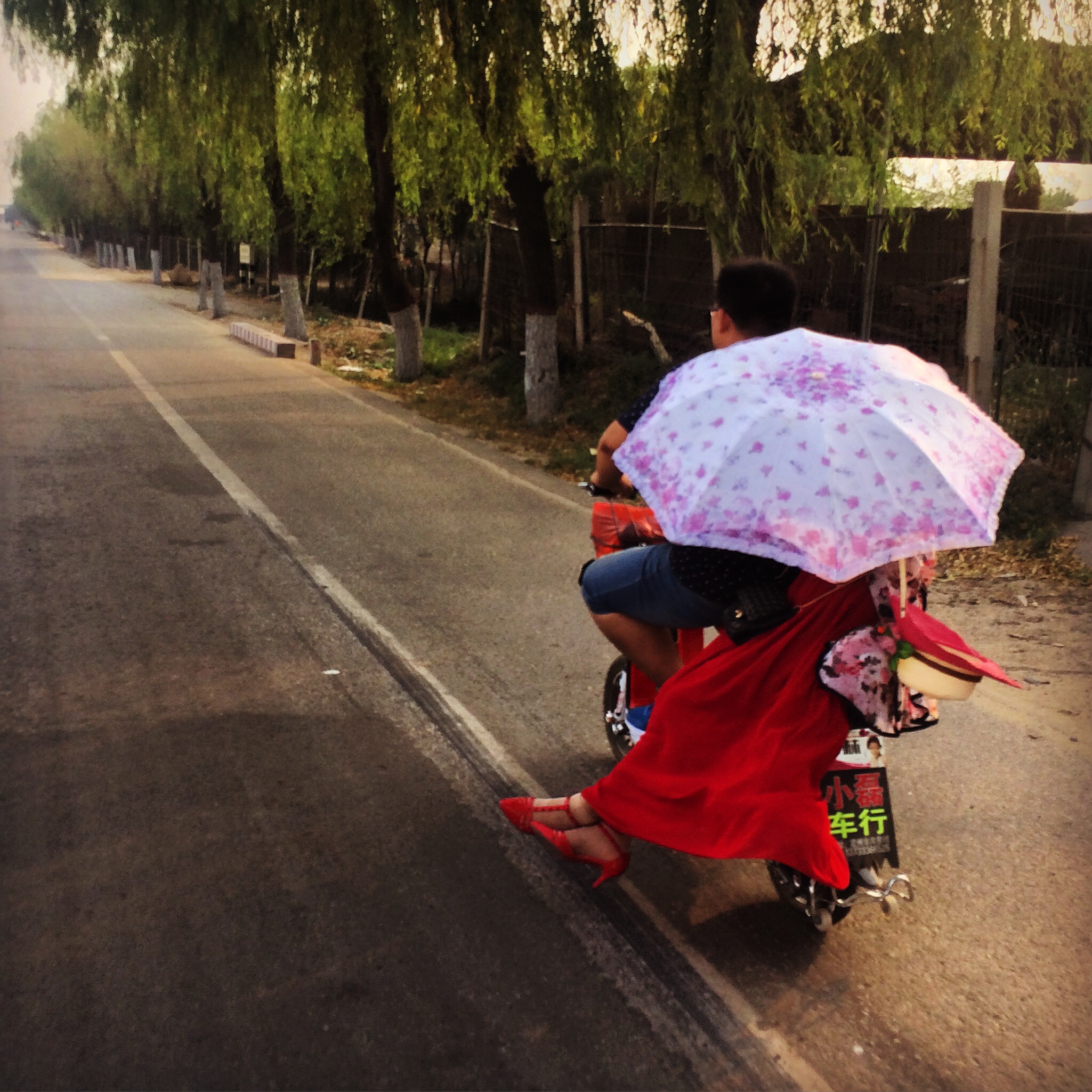
Two weeks and Sebrand and I have already completed level two of our adventure. It picked up right where one left off- in the middle of the desert of what was in many ways a continuation of Mongolia. They don’t call it Inner Mongolia for nothing. But make no mistake – even if there are overwhelming carpets of grass adorning the hills and nomadic huts all around, this is unmistakably China. The difference was immediately and insistently apparent. Zamiin Uud, still in Mongolia, was a lightly populated town you might imagine in the Old West. Erlianhot, on the Chinese side, and more so every town that followed, was a mad house out of Dr. Seuss. In Mongolia they drove Priuses. In China they drive Chinese knock-off Priuses, smart cars, smart trucks, motorcycles, motorcycle trucks, electric bicycles, electric becaks, motorcycles modified to have comfy beds on the back people ride around on, tuk-tuks, whositmobiles, wonkies and even badonkabusses. Not even in Indonesia did I see a family of five and a mid-size dog on one motorscooter. The electric bikes are truly ubiquitous and the most popular form of transport. They line every store front and parking lot, and zip along amusingly with over-sized drivers. Seeing an adult use the little pedals on these ranks pretty highly for me on the list of silly manners of conveyance. Right up there with penguin waddling.

So our first stretch in China really delivered as a second level. Mongolia was a great intro, I won’t deny that, but this second zone really stepped up the diversity of level design and introduced a lot of new and exciting elements to the challenge. There were lots of new obstacles, friendly NPCs, mini-games and far more demands on us to bring the right equipment and think on our feat. They even introduced new genre elements early on. I loved the horror stage on the 2-1. That was a night to remember! (see previous post)
The next day, 2-2, was fairly uneventful. We got jipped into getting an overpriced hotel, but overall this city whose name I can’t even remember wasn’t terribly notable. It was our first flat tire and we got our first Chinese hotpot. The only memorable experience was dinner. We speak zero Chinese. I can recognize a character or two occasionally to find a restaurant, but reading the menus is beyond me. So when we choose restaurants, we choose ones that look locally popular and outside of what we’re used to. When we walked by a place with a small boy wearing a paper crown encircled at his table by smiling family and friends for his birthday, we decided this was definitely the place to be. It was an excellent choice, because this scrawny little boy with glasses far too large for his face and a geeky bowl cut was the only one in the restaurant who spoke any English and it was his time to shine in front of his family. He was swiftly recruited to take our orders. We weren’t even shown menus. The boy, we guessed he was about thirteen, asked us what we wanted. We of course didn’t know what the restaurant served, so we shrugged and exchanged nervous smiles. The kid thought for a minute, then confidently and loudly asked, “Would you like vegetables?” Yes. “What vegetables do you like?” Lots. “Do you like tomatoes?” Sure. “Do you like eggs?” Yeah, why not. “How about rice?” Definitely. “Chicken or beef?” I don’t remember which we chose at this point, but he presumably muttered our preferences to the nervously hunched waitress behind him, who smiled proudly at his translation efforts. His mother was filming everything from the next room. We sat down with an audience of beaming family members. For a while, we were left in peace as our order was prepared. We anticipated some sort of fried rice dish combining the ingredients we said we liked. This made it particularly funny when our order was taken literally, and out came a plate of tomatoes and fried eggs, with a bowl of steamed rice to the side, and a plate of spicy meat. The boy had translated exactly what we asked for. He excitedly approached us to check if we were pleased, and we couldn’t do anything but laugh and praise his fantastic waiting. When we finished, he interpreted our bill for us, and we learned a little about him. We were right that it was his birthday, so we sang Happy Birthday for him, though shockingly we discovered he was sixteen and not twelve or something. His mom came over to thank us, and there came the punchline of the whole experience with a final demonstration our new friend’s excellent English. Sebrand compliment him to his mother, “Your son has excellent English. You should be very proud of him.” Without missing a beat, Sebrand was corrected, “Oh, no! But… I am a girl!” “Ah… Ummmm… Let’s… Uh… We should go. Happy birthday!” We take comfort that at least her mom probably didn’t catch on to that mistake. We were the fools in this story, and she a truly sharp student of the language! We definitely had a good laugh about it.
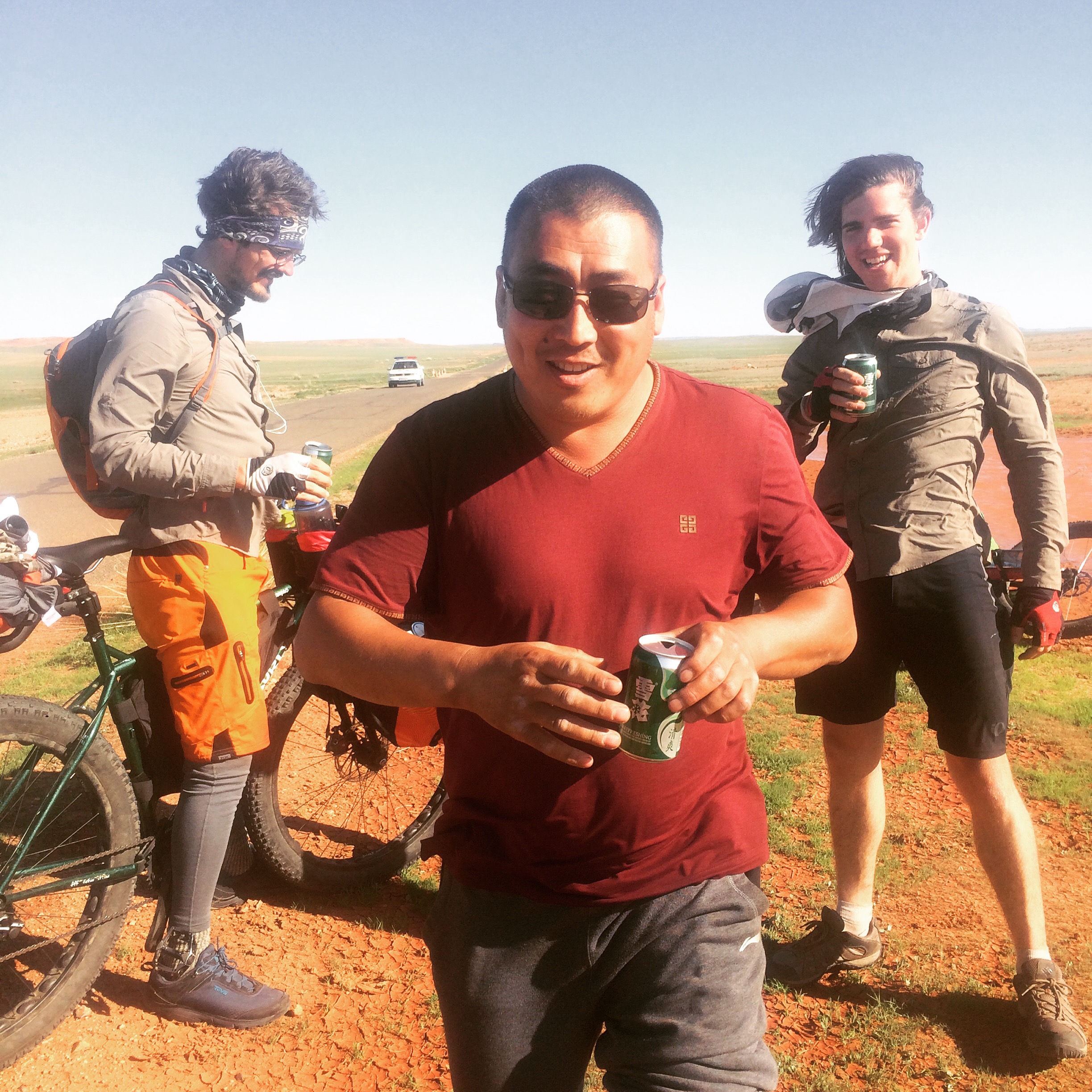
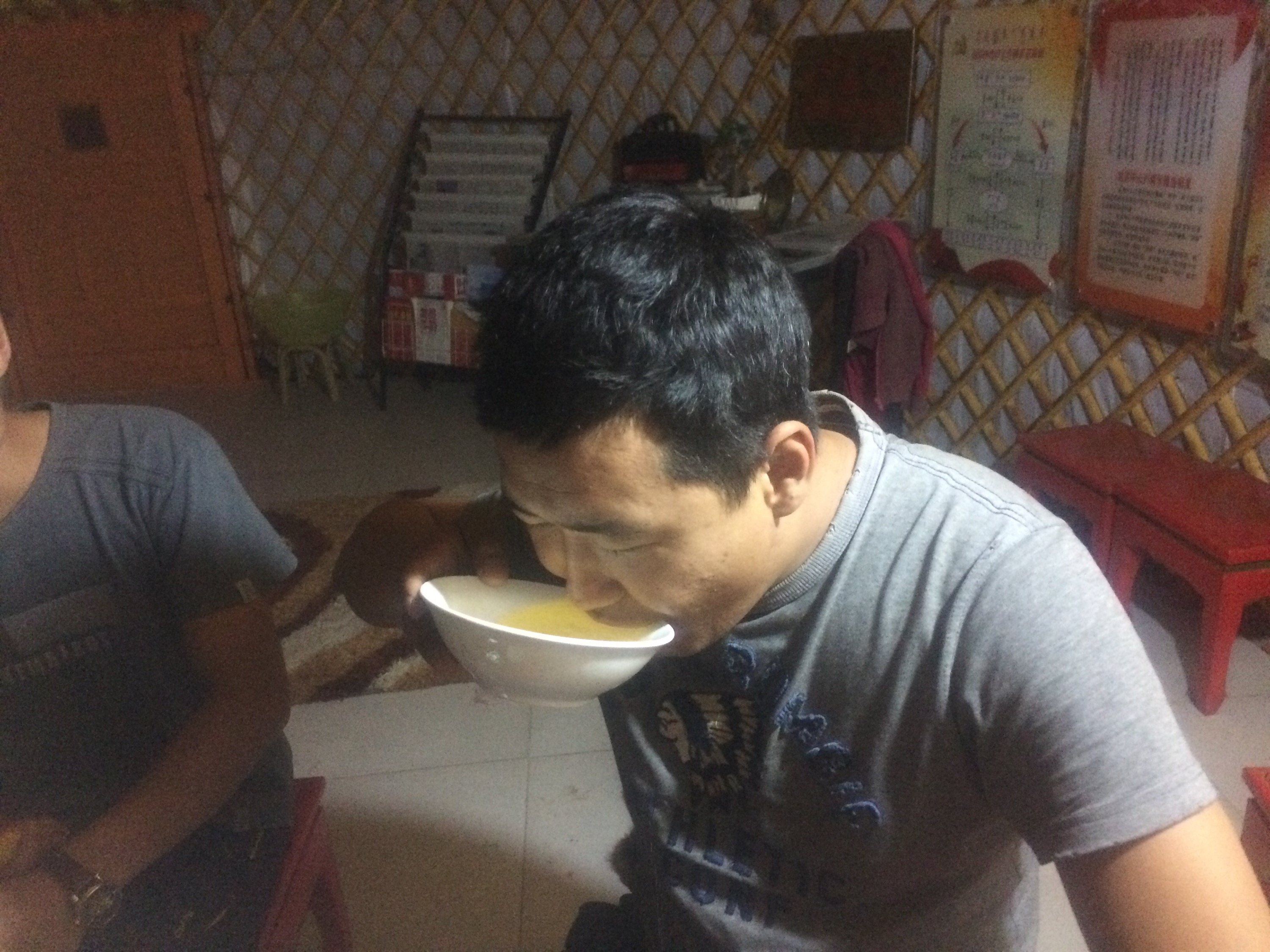
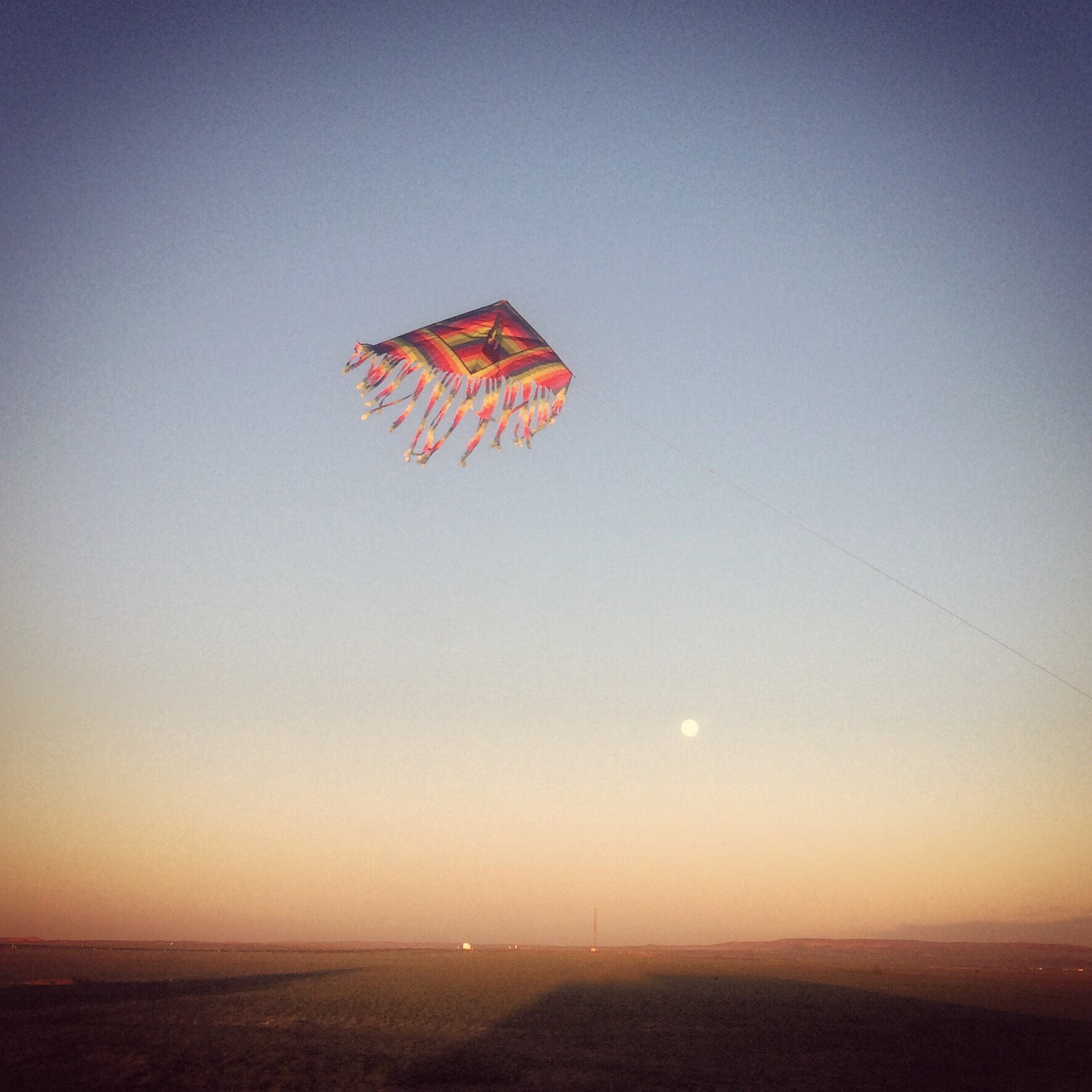
We continued our ride on the next day, 2-3, and got to experience a whole new host of mini games with Arugot and his family in the steppe of Inner Mongolia. Their hospitality was difficult to escape. This adventure almost became a casual game. I’d easily have given in to two months there were it not for our commitment to the main quest. Like so many games in this genre, it’s easy to get distracted by the sidequests and miscellaneous activities, even if they are an important part of the game. We got lost for two nights, having baiju drinking contests with Mongolians in which we were steeply outmatched- Sebrand puking on the floor of the ger and I left sobbing at the thought of having to drink even another sip from my watered down glass. Our new friend from Quebec, Marie Christian, wasn’t allowed to participate, as it was declared that baiju is for men. Women, Erugot declared, drink beer. Sebrand protested, but Marie, wisely we realized, let it be. She was happy not to take part in this hopeless game. On 2-4 we spent all day recovering and messing around. This is all for another post, but the diversions included herding sheep, foraging mushrooms, making Mongolian steamed bread, motorcycling, and helping Erugot with his favorite hobby: flying kites. There’s something truly adorable about watching a grown man so happily sailing his kite in the vast peaceful fields of his family’s farm, and being so proud to have guided it so high in the sky. We escaped on 2-5, but not until after some sheep sheering and feeding a motherless lamb with a milk bottle. This was one of the great aspects of this stage. The experience was so much more diverse than the pure cycling of level 1.
The rest of 2-5 was incredibly easy! It wasn’t a terribly long ride to Zhangbei, and the hills we were well prepared for, especially with the wind at our backs. We biked straight past it well into the night, and had to stop only because Huade, the next city, had its northern road demolished and we couldn’t figure out the detour in the dark. We wound up sleeping on the side of the highway without any tent- just our tarp and sleeping bags. That gave us our usual distance of 100km for the day, which was pretty good for having started at around 4pm and finishing at 9pm. The next day, 2-6 was even easier. It was a gorgeous descent down the plateau. The task was simple: fly downhill on a small road, avoid being distracted by the views of the unbelievable and otherworldly Chinese landscape, and dodge the constant traffic heading the opposite direction. Trucks and cars were passing each other without concern for cyclists, and seeing one coming right at you as you round the curve required some serious concentration and quick reflexes. Sebrand of course was unphased and just leaned in to coast downhill as fast as possible. I met him at a restaurant near the bottom. We got a plate of mushrooms and a plate of tofu there, again having our order interpreted exactly as we gestured, without considering that maybe we wanted the ingredients mixed in some sort of dish. But that’s probably on us for not learning any Chinese. What’s not cool is that she charged us 76 yuan, which was about three times what it was worth.
We finished 2-6 in Zhangjiakou, the first big Chinese city on our trip, the totally guaranteed location of the 2022 Winter Olympics no way no how it won’t get it we already rebuilt the whole place, and what we thought was the best place to see the Great Wall. No seriously, they rebuilt the wall there and the historical village, and there are tons of Olympic themed statues all around it proclaiming it the victor in the selection process (to be announced next week). Here we got ourselves mired in a new side quest: find a place to stay so we can locate the Wall in the morning. You see, according to the maps we’d seen when our Internet worked, the Wall site was somewhere 20km north of the city, and it being pretty late in the evening already, we though we’d find it the next morning then head off. So we began a search for hotels, hostels or kind residencies. First hotel: full. Next hotel: full. Hotel after that: not full, oh wait you have bikes. Nah we’re full. Neeext hotel: full. Finally we reached the poor neighborhood, and bumped into the seediest, smallest hotel yet- a staircase with some rooms attached. Just what we wanted. They motioned us in, said they had a place for us, looked at our passports aaaaaaaand “Sorry we’re full.” About then we did our best impression of Mary and Joseph, and a person we assumed worked for this grand accommodation took pity on us. He motioned us to follow him on his ridiculous electric bicycle. This was the start of a challenging mini game. Zhangjiakou is a huge city. It’s got heavy traffic and the roads are chaos. Pedestrians, cars and miscellaneous vehicles are popping out every which way. We followed this guy for twenty minutes through the madness until eventually he brought us to the nicest and most expensive hotel in the area. We shook our heads and motioned “poor foreigner” as best we could. He nodded in understanding and we were off again. This time we arrived at a slightly cheaper place. Still, 80 USD for a night was steep for us. This time I wrote a price range down for him. A hundred and fifty yuan was our max. He called someone (apparently he has a network for these things) and brought us to one last place, again having to follow him like we were biking the streets in a Grand Theft Auto game, completely ignoring any rules of the road. He brought us to a place double our price range. At this point we told him we’d camp somewhere, and while he insisted it would be too cold, we thanked him and disappointedly parted ways. We biked north for two minutes, and around the corner there was the Great frakking Wall of Bloody China right there, the sneaky bastard. The whole day wasted and it was right there in the damn downtown. It was dark, there were arrays of old ladies out front doing calisthenics in synchrony with an enormous juke box blaring high pitched rhythmic Chinese opera. Dignified, I know. But there it was, not 20km north of the city at all. This part was called the Mirror Gate. Its gate was pretty non-reflective, but it was still an impressive wall. A little disappointing in length, but with the old Chinese town behind it restored, it was an excellent time piece. We found a covert place behind it and layed out our sleeping bags. On a soggy lane with our shoulders pressed against the Great Wall of China, we slept.
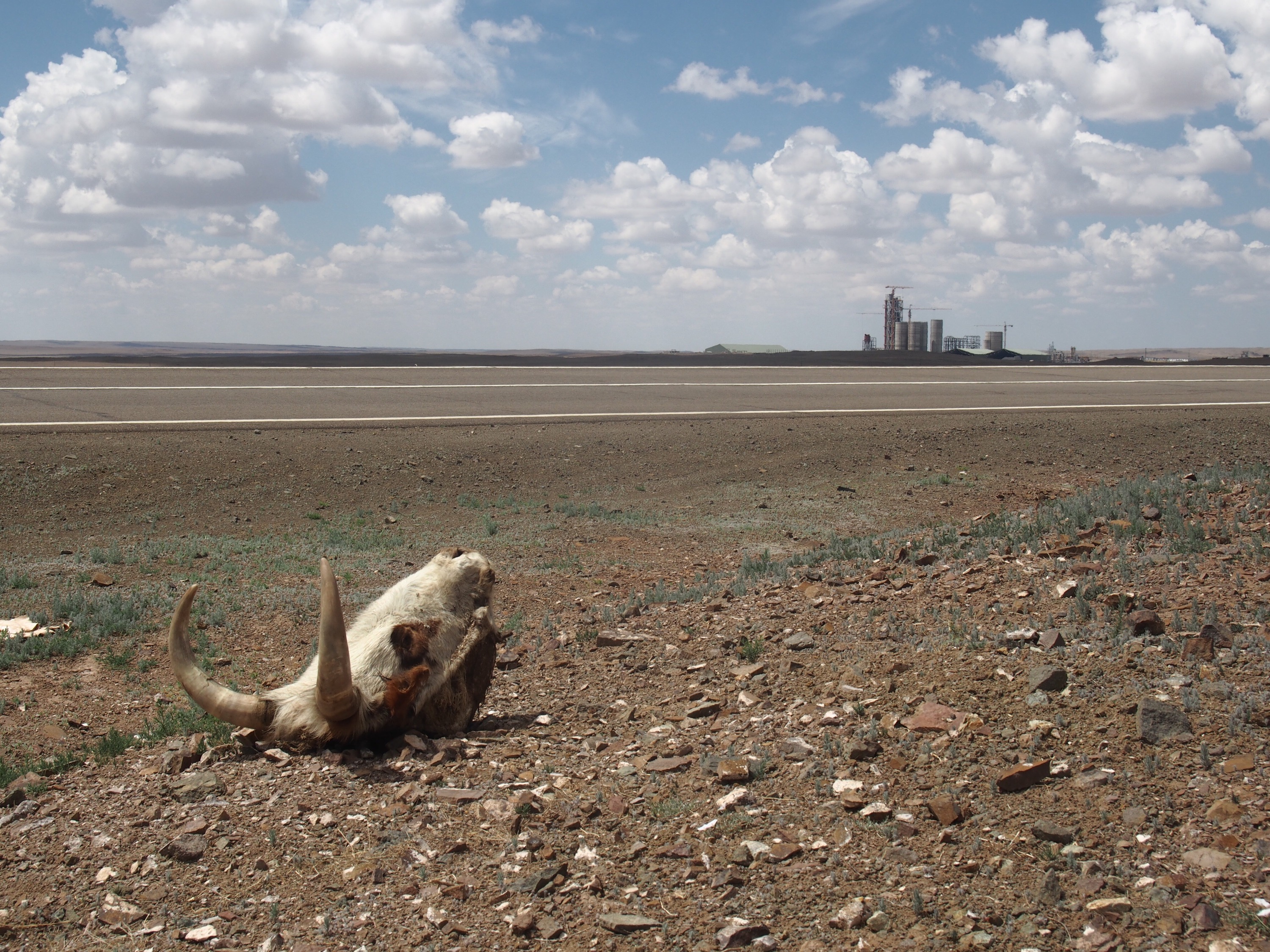
The next day was 2-7, we began early, waking at 4am to be up and about before being discovered sleeping where we shouldn’t. As we walked out to the gate again, there were still old ladies, still doing calisthenics, as if they hadn’t stopped from the night before. Chinese ladies are weird. We took a walk along the old wall, the original parts all collapsed into stone piles along the mountain ridge. Satisfied with this landmark, and merely 210km from Beijing, we were again on the final challenge. The road before us was tough. Leaving Zhangjiakou was a dangerous affair, evading pedestrians through bustling markets and buses on chaotic streets. I didn’t make it out without damage. I’m in pain even here in Beijing as I type this, and haven’t been able to sleep without painkillers for the last couple of nights. As we threaded through the traffic, a young girl jumped out of bus in front of me, leaving me floored five feet from my bike, slamming my left elbow hard into my ribcage. This has become a handicap. I can’t lift even light bags with my left arm without causing severe pain to my lower left ribs. Biking was only possible if I locked my upper body in a single posture. This last part was looking pretty bad. We were committed to 100km. We’d barely done ten. We got going, and 2-7 has become one of the most difficult and exciting challenges of the trip so far. There is a huge mountain range between Zhangjiakou and Beijing. The first part is an enormous hotbed of coal mines. Enormous coal trucks pollute the route. It’s straight up and straight down, time after time. The visuals are astonishing – great narrow crags shoot into the sky as if pushed out of a thin mold, and large sink holes, once mines, like miniature canyons flank the highway, rich with green crops. We came upon a gas station around 50km in. Our road was to the left of it. To the right hundreds of workers on scaffolding were at work constructing a new mining town. The man there refilled our bottles with hot water.
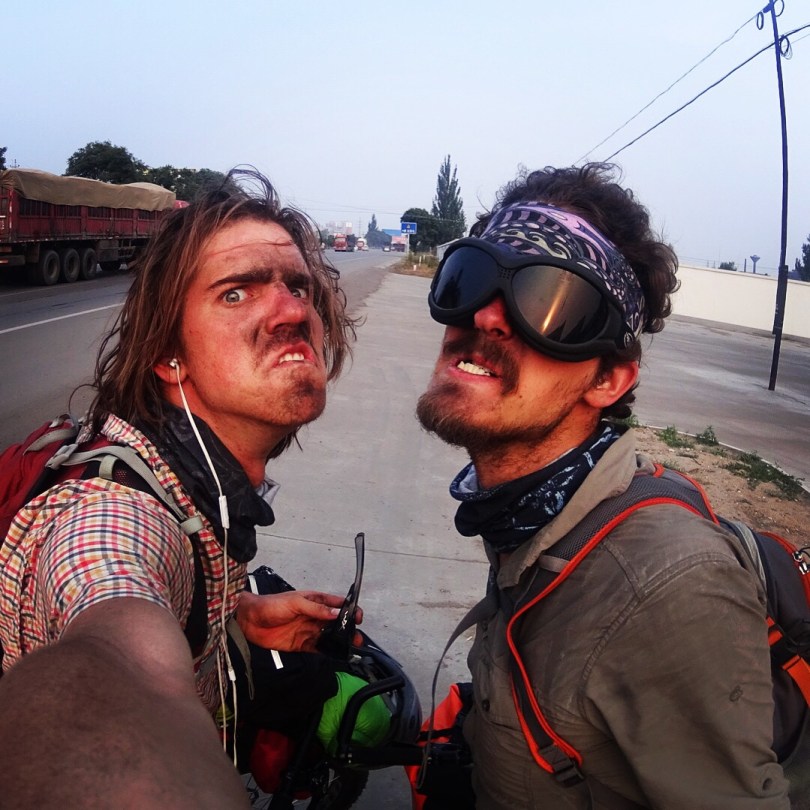
The final gauntlet was well marked. Two snarling stone lions with their smokey manes stood at the start of a long straight. Trucks and warm wind kicked up clouds of coal sand. “Stock up on potions and equip your best gear,” they warned. Already blackened by smog, we lowered our goggles, raised our bandanas over our mouths, and geared up for the fury road. What a lovely day! The introduction of new obstacles here was perfectly done for the final challenge of the second level. The were the toughest hills yet, the wind was in our faces, the trucks would tug and toss us with the vacuum they created as they passed, and breathing was difficult. But with a little cunning, and an exciting new ability, they gave us the tools we needed to complete the challenge! On the climbs, trucks had to slow down, and if we pedaled hard enough, we could match speeds with them and reach their back ends. We could then grab on, and be pulled up the hills with relatively small effort. This was painful for me, since my injury made accelerating hurt quite a bit, and I could only use my right arm to grab the back of the trucks. But we pulled it off, and completed the whole run of the mountain range before sunset. We looked about as good as we felt though. Hair windswept, coal blackened our faces, teeth, hands and clothes. Even as I licked my fingers clean of fruit that we had for snack, it was accompanied by dirt and grime. We arrived in a satellite town of Beijing, just 130km from downtown. We found a hotel and were greeted with enormous sympathy. The woman at the desk looked like an angel. A kid, no more than ten, helped us check in with her. We felt bad having her ride the elevator with us to our room, covered in soot and smelling like animals. We had the most rewarding showers of the whole trip, and washed our clothes in the sink. It was cathartic.
But we weren’t in Beijing yet! Like in Mongolia, the last challenge of the stage was a two part deal. First through the coal mines, now down the final stretch of the plateau and into the massive city. We left at noon sharp. The wind was favorable, and the roads beautiful. In contrast to the previous day, 2-8 brought us through wetlands and forests, and by an enormous lake. The air was fresher, though the sun was veiled already by the Beijing smog blanket, even this far away. We started again uphill until we came upon a tunnel, marked 2850 meters in length. We popped on our lights and proceeded through, zooming downhill. The acoustics of the tunnel created a wail like a jet engine as the wind rushed passed us and we burst through this corridor. Bristling with adrenaline we emerged into the clear once more, finding ourselves among the mountains again, but this time with the true and fully restored Great Wall lining every ridge. What we had seen in Zhangjiakou was just a sad shade of this spectacle. The tunnel could not have been a more appropriate build up to this moment as we stopped in awe. Cycling along these roads, all downhill to Beijing, there wasn’t anywhere you could look that wasn’t fortified by the famous structure. Zhangjiakou, in other words, was a huge waste of time. We should never have bothered with it. Also worth noting on this road- for some reason it’s covered in bees. There are beekeepers and their little hives selling honey the whole way through the mountain range. I only mention this because bees were pelting me in the face constantly on the way down while I was trying to appreciate the views and simultaneously clear the way for huge tour buses.
This was all easy going and a good reward for the day before, but the hard part of 2-8 was Beijing itself. Zhangjiakou was training for this. A test of wits and concentration instead of fitness like 2-7. One of the largest cities in the world, at rush hour, Beijing is an incredible place to navigate on a bike. And they are accustomed to doing so. Everyone is on a bicycle. The last 30km to our couch surfing destination took three hours, which we normally do in one and a half. Here’s what cycling in Beijing is like. There are bike lanes throughout; even the margins on highways are marked as such. Cars and other high speed vehicles occupy the larger lanes (though occasionally they use the margins as well), cyclists and pedestrians use the bike lanes, and smaller vehicles like motorcycles switch between the lanes as they like. The bike lanes are perilous, because while 80% of the traffic is going the correct direction on these one-ways, the other 20% of motorcycles, bikes and fruit carts couldn’t be bothered to cross over and are in fact driving the opposite direction. This is considered normal. So we dealt with this most of the way in: cycling as fast as we could weaving past traffic from all directions, cars turning in front of us without warning, motorcycles doing whatever the hell they want, pedestrians walking out in front of us, and crossing nightmarishly complex intersections all while trying to navigate with shitty maps that wouldn’t load. This was the easy part. The hard part was when we were forced to cross the street and become what we had feared earlier. Now we were part of the 20% going the wrong way down a one-way bike lane. This was tough. We found generally that the side of the road you have to use reverses when you pretend these single lanes are two lane. We cycle on the left, hugging the sidewalk. Forget going on the right and possibly being pushed into oncoming traffic. I’d rather hit a pedestrian than be hit by a car.
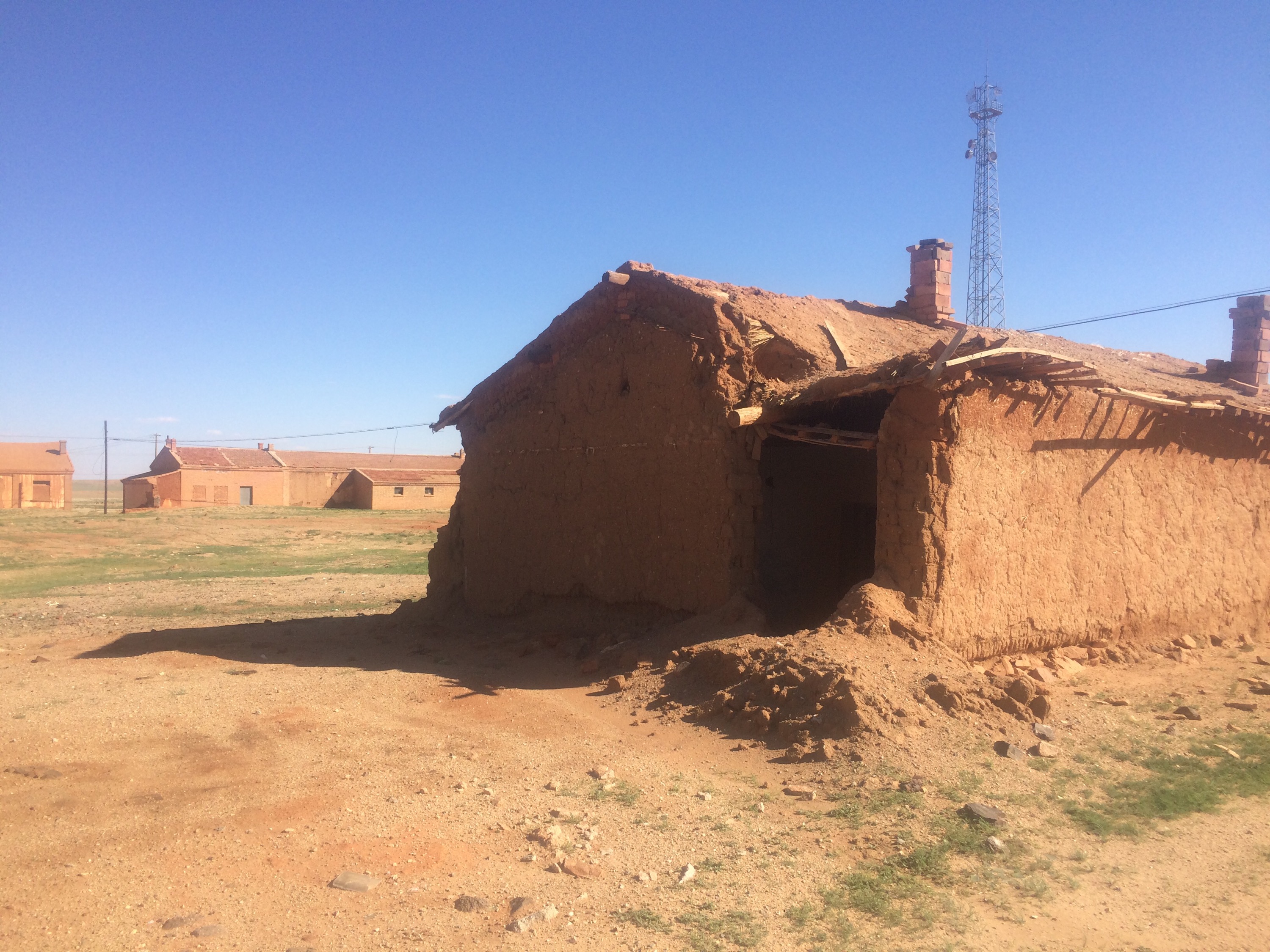
Somehow we managed to pull it off though. Here we are in a comfy apartment in Beijing. I’m nursing my ribcage back to health. Taking it easy. Level 2 really had it all. It took the elements that were good from level 1, made them more challenging, and added a host of new mechanics and designs. In addition to arid shrub desert and grassy hills we passed through crowded city marketplaces, muddy fields, villages of ruined brick, through windmill forests into a green basin, past the Great Wall, through coal mines and dark tunnels, over wet lands and by lakes and over some of the most beautiful mountainscapes we’ve ever seen. We faced personal injury, smog, dust, sand, rain storms, traffic, clouds of coal, and vicious hills and winds like never before. Most of all we met many new friends and experienced new foods. Who knew it was common place in China to put whole pieces of garlic next to your plate for separate consumption? No not just a segment, the whole damn thing. And no, not in the dish. God for bid they cook it into whatever it is you’re eating. You gnaw on this thing on its own. We’re loving China. It’s been all we could hope for in an adventure.
10/10














 Biking Across China